Benefits of Scentwork for Reactive Dogs | College 4 Canines
Benefits of Scentwork for Reactive Dogs


7
If you live with a reactive dog, you’ll know how exhausting daily walks can feel. Barking, lunging, pulling, or becoming overwhelmed by other dogs, people, bikes, or unfamiliar environments can make even a short outing stressful for both dog and owner. While behaviour modification techniques such as desensitisation, counter-conditioning, and engagement games are essential, one activity is increasingly proving to be a valuable addition to a reactive dog’s training plan: scentwork.
Scentwork allows dogs to use their extraordinary sense of smell to search for food, toys, or target odours. For reactive dogs, this simple act of sniffing can have profound effects on confidence, emotional regulation, focus, and overall wellbeing.
At College 4 Canines, we regularly use scentwork as part of a force-free enrichment and behaviour support programme for reactive dogs.
What Is Scentwork?
Scentwork is a structured activity where dogs search for a specific scent. Beginners often start by finding hidden treats, while more advanced dogs may learn to locate target odours such as birch, clove, or gun oil.
Unlike obedience training, scentwork encourages dogs to work independently, make choices, and solve problems using their nose. This taps into natural canine behaviours that many pet dogs rarely get the opportunity to use fully.
Why Sniffing Matters
A dog’s sense of smell is estimated to be tens of thousands of times more sensitive than ours. Sniffing is not simply a way to identify food—it is how dogs gather information about their environment, other animals, and even emotional states.
Research has shown that scent-based activities can positively influence canine welfare and quality of life. Dogs participating in scentwork classes have been reported by owners to show improvements in perceived wellbeing and enjoyment of life.
ScienceDirect +1
How Scentwork Helps Reactive Dogs
1. Reduces Environmental Pressure
Many reactive dogs struggle because the outside world feels overwhelming. Traditional walks often involve constant exposure to triggers.
Scentwork changes the focus. Instead of scanning the environment for potential threats, the dog concentrates on a search task. This can help interrupt the cycle of hypervigilance that fuels reactivity.
Why it helps
Focus
A dog engaged in searching is often less concerned with what is happening around them.
2. Builds Confidence
Fear is a major component of many reactive behaviours. Dogs who feel uncertain or worried may bark or lunge to create distance.
Scentwork gives dogs repeated opportunities to succeed. Every time they locate a hidden treat or odour, they receive reinforcement for their efforts. This can help create a more confident learner who is willing to engage with challenges.
Many owners of reactive dogs report noticeable increases in confidence after starting nose work activities.
reddit.com +1
3. Provides Mental Enrichment
Reactive dogs are not always lacking exercise—they are often lacking appropriate mental stimulation.
Ten minutes of focused scentwork can be surprisingly tiring because the dog is using problem-solving skills, memory, concentration, and olfactory processing.
For dogs who become over-aroused with high-intensity activities such as ball chasing, scentwork offers a calmer form of enrichment that engages the brain without encouraging frantic behaviour.
4. Encourages Calm, Thoughtful Behaviour
Scentwork rewards slow, investigative behaviour rather than explosive movement. Over time, many dogs begin offering calmer responses because the activity itself reinforces concentration and self-control.
This can be particularly useful for dogs who struggle with frustration-based reactivity.
5. Creates Positive Associations
Scentwork can be paired with controlled exposure to triggers.
For example, a dog may search for treats at a comfortable distance from another dog. The presence of the trigger predicts an enjoyable sniffing game rather than conflict or stress.
This combines the benefits of classical conditioning with the calming effects of searching.
The Science Behind Scentwork and Stress
While research on scentwork for reactive dogs is still developing, studies on canine welfare and olfactory enrichment provide encouraging evidence.
Research highlights
Evidence-based
Dogs in scentwork classes have shown improvements in owner-perceived quality of life.
ScienceDirect
Olfactory enrichment has been associated with positive welfare outcomes and, in some studies, reductions in stress-related measures such as cortisol.
ScienceDirect +1
Scent activities engage natural behaviours that are considered inherently rewarding for dogs.
ScienceDirect +1
It is important to remember that excitement during searching is not necessarily the same as stress. A dog may show increased enthusiasm and engagement while still experiencing the activity as enjoyable and enriching.
ScienceDirect +1
What Types of Reactivity Benefit Most?
Scentwork can be useful for many reactive dogs, including:
Dog-to-dog reactivity
Fear-based reactivity
Frustration reactivity
Noise sensitivity
Environmental anxiety
Adolescent over-arousal
It is especially valuable for dogs who find traditional group classes too stimulating, as searches can often be set up with greater distance and fewer direct interactions.
Easy Scentwork Games to Try at Home
The Treat Scatter
Scatter a handful of kibble or treats in the grass.
Let your dog sniff them out.
Allow plenty of time—don’t rush the search.
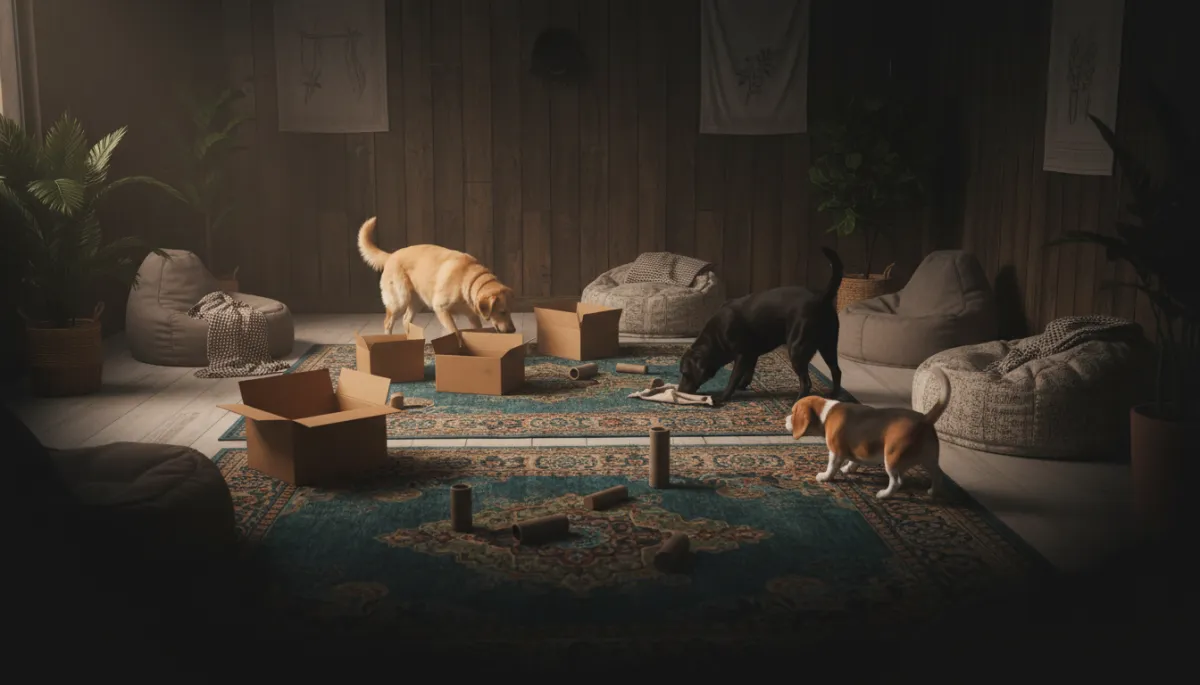
The Box Game
Place several cardboard boxes on the floor.
Hide a treat in one box.
Encourage your dog to investigate.
Gradually make the searches more challenging.
Find It
Ask your dog to wait.
Hide a treat behind a chair or under a towel.
Release them with “Find it!”
Scentwork on Walks
If your dog is reactive outdoors, try short “find it” searches at a safe distance from triggers. This can help redirect focus and lower overall arousal.
Common Mistakes to Avoid
Keep searches easy at first
Making searches too difficult too soon: Success builds confidence.
Adding triggers before the dog is ready: Start in a calm environment.
Rushing the dog: Sniffing works best when the dog can investigate at their own pace.
Using scentwork as the only treatment: It should complement a full behaviour modification plan, not replace it.
When to Seek Professional Help
If your dog shows severe reactivity, has a bite history, or becomes overwhelmed even at large distances from triggers, professional guidance is recommended.
A qualified force-free behaviour professional can help you integrate scentwork safely alongside desensitisation, counter-conditioning, management strategies, and confidence-building exercises.
The Bottom Line
Scentwork is far more than a fun game. For many reactive dogs, it provides a powerful outlet for natural behaviour, helping them feel more confident, engaged, and emotionally balanced.
By allowing dogs to use their nose, we tap into one of their strongest innate abilities. Whether your dog reacts to other dogs, people, noises, or busy environments, scentwork can become an invaluable part of a force-free training programme.
At College 4 Canines, our scentwork classes are designed to help dogs build confidence, enjoy mental enrichment, and develop calmer focus in a supportive environment. If you’d like to discover whether scentwork could benefit your reactive dog, get in touch to learn more about our classes in Northumberland.
Learn more at;
www.college4canines.co.uk/scentwork
References
Sobol, S. & Dowling-Guyer, S. (2026). Effects of scentwork and traditional training classes on dog welfare, behavior, and human-dog bond. Applied Animal Behaviour Science.
ScienceDirect
Fountain, J. et al. (2026). Heart rate variability and behaviour in dogs during and after scent work. Applied Animal Behaviour Science.
ScienceDirect
The value of sniffing: A scoping review of scent activities for canines (2024). Applied Animal Behaviour Science.
ScienceDirect
Shin, Y. & Shin, N. (2016). Evaluation of effects of olfactory and auditory stimulation on separation anxiety by salivary cortisol measurement in dogs.
PMC