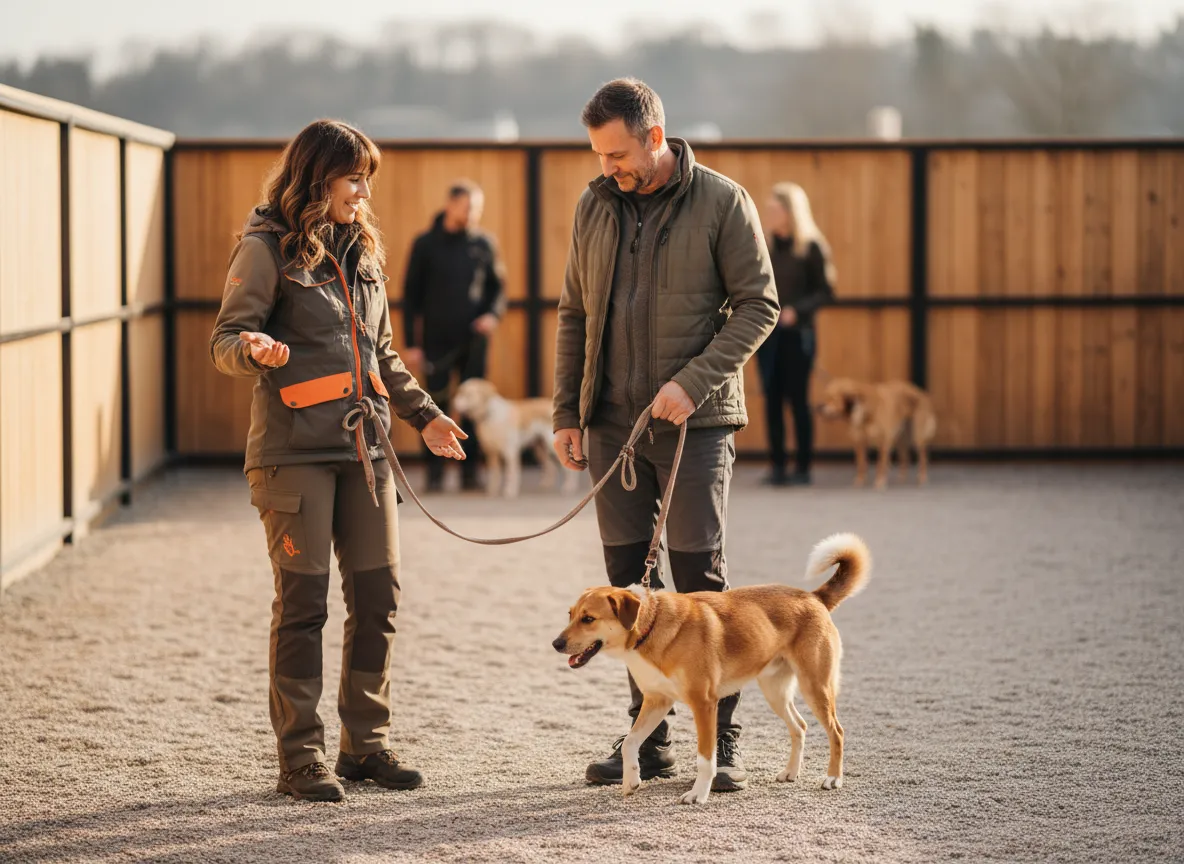
Exposure Training for Dogs: Using Desensitisation and Classical Conditioning to Change Behaviour
Exposure Training for Dogs: Using Desensitisation and Classical Conditioning to Change Behaviour
Many dog owners are told that their dog simply needs “more exposure” to the things they fear. Unfortunately, this advice often leads to overwhelmed dogs, frustrated owners, and behaviour that becomes worse rather than better.
Whether your dog barks at other dogs, lunges at people, fears loud noises, struggles with traffic, or becomes anxious in unfamiliar environments, effective behaviour change requires much more than simply exposing them to the trigger repeatedly.
At College 4 Canines, we use science-based, force-free behaviour modification techniques including desensitisation and classical conditioning to help dogs develop positive emotional responses to previously challenging situations. Understanding how these methods work can make the difference between successful behaviour change and unintentionally making a problem worse.
What Is Exposure Training?
Exposure training simply means allowing a dog to experience a trigger or situation that causes an emotional response.
The trigger may be:
Other dogs
Strangers
Vehicles
Loud noises
Veterinary handling
Being left alone
Novel environments
Exposure itself is neither good nor bad. The outcome depends entirely on how that exposure is managed.
Many owners assume that if a dog is repeatedly exposed to something they fear, they will eventually “get used to it.” While this occasionally happens, more often the opposite occurs. Repeated exposure above the dog’s coping threshold can increase fear, anxiety, frustration, and reactivity over time. Behaviour professionals often refer to this as flooding.
Instead of learning that the trigger is safe, the dog may simply learn that they have no control over the situation while continuing to experience fear.
For successful behaviour change, exposure must be carefully structured and paired with positive experiences.
Understanding Emotional Responses
Most reactive behaviour is driven by emotion rather than disobedience.
A dog that barks and lunges at another dog is often experiencing:
Fear
Anxiety
Frustration
Over-arousal
Uncertainty
Likewise, a dog that panics during fireworks is not choosing to misbehave. They are responding emotionally to something they perceive as threatening.
This is why punishment rarely solves behavioural problems. It may suppress outward behaviour temporarily, but it does not address the underlying emotional state. College 4 Canines focuses on identifying and changing the emotion driving the behaviour rather than simply suppressing symptoms.
What Is Desensitisation?
Desensitisation is a behavioural technique that gradually reduces a dog’s sensitivity to a trigger by exposing them to it at a level they can comfortably cope with before slowly increasing intensity over time.
The key word is gradually.
For example, if a dog reacts to other dogs at a distance of 20 metres, asking them to walk through a crowded park is unlikely to be successful.
Instead, we might begin working at 50 metres where the dog can notice another dog without becoming stressed.
Once the dog is consistently comfortable at that distance, we can gradually reduce the gap over multiple sessions.
This approach allows the dog to remain under threshold and capable of learning.
What Does “Under Threshold” Mean?
Threshold refers to the point at which a dog becomes emotionally overwhelmed and unable to process information effectively.
Signs a dog may be approaching or exceeding threshold include:
Barking
Lunging
Growling
Freezing
Excessive panting
Refusing food
Hypervigilance
Inability to respond to cues
Effective desensitisation occurs below this threshold.
If your dog cannot take food, engage with you, or relax in the presence of a trigger, they are likely too close and learning becomes significantly more difficult. Many experienced behaviour professionals emphasise that successful exposure work should occur while the dog remains under threshold and able to notice the trigger without reacting.
What Is Classical Conditioning?
Classical conditioning involves creating an association between two events.
One of the most famous examples is Pavlov’s dogs, who learned that a bell predicted food.
The same principle applies in behaviour modification.
If every appearance of a trigger predicts something wonderful, the dog’s emotional response can gradually change.
For example:
Dog appears → Chicken arrives
Person appears → Cheese arrives
Traffic passes → High-value treats arrive
Over time, the trigger begins to predict good things.
The dog’s emotional response shifts from:
“That thing is scary.”
to
“That thing makes good things happen.”
This process is known as counter-conditioning and is one of the most effective force-free behaviour modification techniques available. Counter-conditioning aims to change the dog’s emotional response by pairing the trigger with positive outcomes such as food, praise, or play.
Why Exposure Alone Often Fails
Many owners unknowingly use exposure without conditioning.
For example:
Walking a fearful dog through busy streets every day.
Taking a reactive dog repeatedly to crowded parks.
Forcing a nervous dog to interact with strangers.
Repeatedly exposing a noise-sensitive dog to loud sounds.
The dog experiences the trigger, but nothing changes emotionally.
In some cases, repeated exposure can actually strengthen the negative emotional response because the dog repeatedly rehearses fear, anxiety, or reactivity. Controlled exposure paired with positive experiences is far more effective than simply hoping the dog will “get over it.”
A Practical Example: Dog Reactivity
Imagine a dog that barks and lunges whenever they see another dog.
A traditional exposure approach might involve walking near dogs repeatedly and hoping the dog becomes accustomed to them.
A desensitisation and classical conditioning approach would look very different:
Step 1: Find the Threshold Distance
Determine how far away another dog needs to be for your dog to remain calm and able to take treats.
Step 2: Pair the Trigger with Something Positive
The moment your dog notices another dog, begin delivering high-value treats.
The treats stop when the other dog disappears.
Step 3: Repeat Consistently
Over multiple sessions, your dog learns:
“Other dogs predict chicken.”
rather than:
“Other dogs are scary.”
Step 4: Gradually Reduce Distance
Only once your dog consistently remains relaxed do you decrease distance slightly.
Progress should always be based on your dog’s emotional state rather than a fixed timeline.
Common Mistakes During Desensitisation
Moving Too Quickly
The most common mistake is reducing distance too soon.
Behaviour change takes time. Rushing often leads to setbacks.
Working Above Threshold
If your dog is barking, lunging, trembling, or refusing food, the training setup is likely too difficult.
Using Low-Value Rewards
The trigger must predict something genuinely valuable.
For many dogs this means:
Chicken
Cheese
Sausage
Liver treats
Inconsistent Practice
Occasional training sessions produce slower results than frequent, controlled exposures.
How Long Does It Take?
One of the most common questions we hear is:
“How long before my dog is fixed?”
The answer depends on:
The severity of the behaviour
How long it has been occurring
The dog’s genetics
Previous learning history
Consistency of training
Some dogs show improvement within weeks.
Others require months of structured behaviour modification.
Success should not be measured solely by whether the dog stops reacting. Improvements in body language, recovery time, confidence, and ability to remain under threshold are all signs of progress.
Professional Support Makes a Difference
Behaviour modification can be challenging because every dog is different.
Determining threshold distances, selecting appropriate rewards, reading body language, and progressing at the correct pace requires experience and careful observation.
At College 4 Canines, our behaviour consultations focus on understanding the underlying emotions driving your dog’s behaviour before creating a tailored force-free behaviour plan. We combine management strategies, desensitisation, classical conditioning, and positive reinforcement training to help dogs feel safer, more confident, and better able to cope with the world around them.
If you are struggling with a reactive, fearful, or anxious dog, professional support can make the process clearer, safer, and more effective.
Need Help with a Reactive, Fearful or Anxious Dog?
If your dog struggles with reactivity, fear, anxiety, aggression, noise sensitivities, or other behavioural challenges, you don’t have to navigate it alone.
College 4 Canines provides professional force-free behavioural support throughout Northumberland, helping owners understand why behaviour occurs and how to create lasting positive change.
Book your FREE assessment call today at https://www.college4canines.co.uk/behaviour-northumberland and discover how a personalised behaviour plan can help your dog feel calmer, more confident, and more successful in everyday life.